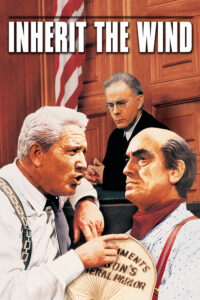
Monday, September 21, 2026 • 7:00 PM • Arena Theater • 214 Main Street
Tickets: $15 General • $12 Arena Theater Members • Under 21 Free
Inherit the Wind is the acclaimed 1960 courtroom drama inspired by the famous Scopes “Monkey Trial” of 1925, when a Tennessee teacher was prosecuted for teaching evolution in a public school.
Spencer Tracy and Fredric March star as opposing attorneys in a courtroom battle that quickly becomes about much more than a single teacher or a single law. At its heart, Inherit the Wind asks enduring questions about freedom of thought, religious belief, education and the right to question accepted ideas.
More than sixty years after the film was released—and a century after the trial that inspired it—those questions remain familiar. How should a society balance deeply held religious beliefs with freedom of inquiry? What happens when government becomes involved in deciding which ideas may be taught? And can people with profoundly different beliefs share the same civic space?
Film Details
Director: Stanley Kramer
Release Year: 1960
Running Time: 128 minutes
Rating: Approved
Genre: Drama / Historical Drama
Country: United States
Distributor: United Artists
Why Inherit the Wind?
In his 1941 State of the Union address, President Franklin D. Roosevelt described four fundamental freedoms that he believed people everywhere should enjoy.
One was Freedom of Worship.
Roosevelt described it as the freedom of every person to worship God in his or her own way.
Inherit the Wind approaches that freedom from an important direction: genuine religious liberty depends not only upon protecting the right to believe, but also upon allowing others the freedom to think, question and believe differently.
The film dramatizes the tension that can arise when religious conviction, government authority, education and individual conscience collide. Rather than asking audiences to choose between faith and science, it invites us to consider what freedom of belief requires in a diverse society.
The Four Freedoms
On January 6, 1941, with much of the world already at war, President Franklin D. Roosevelt told Congress that the future should be founded upon four essential human freedoms:
Freedom of Speech and Expression
Freedom of Worship
Freedom from Want
Freedom from Fear
Roosevelt deliberately described these as freedoms for people “everywhere in the world.”
The Four Freedoms later helped shape international discussions about human rights and inspired Norman Rockwell’s famous series of paintings illustrating each freedom.
More than eight decades later, the questions behind the Four Freedoms remain remarkably current.
About Freedoms on Film
Freedoms on Film uses great movies as a starting point for exploring Franklin D. Roosevelt’s Four Freedoms and what those ideals mean today.
Each screening approaches one of the freedoms from a different perspective. The films are not intended to provide a single political viewpoint or a definitive answer. Instead, they invite us to watch, think, discuss and consider how ideas articulated more than eighty years ago continue to intersect with American life.
2026 Series
September 7 — Freedom from Want
Roger & Me
September 21 — Freedom of Worship
Inherit the Wind
October 12 — Freedom of Speech
All the President’s Men
October 26 — Freedom from Fear
The Great Dictator
November 2 — Democracy
Mr. Smith Goes to Washington
Five films. Four freedoms. One democracy.