
 About Freedoms on Film
Five Films. Four Freedoms. One Democracy.
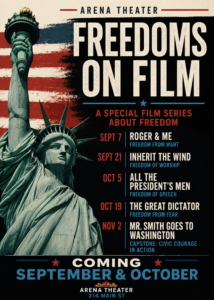
Freedoms on Film is a five-film series that uses movies to explore some basic questions about freedom, democracy, and what they mean in our everyday lives.
The idea for the series comes from President Franklin D. Roosevelt’s Four Freedoms. In a 1941 speech, as much of the world was already at war, Roosevelt described four freedoms he believed everyone should have: freedom of speech, freedom of worship, freedom from want, and freedom from fear.
More than 80 years later, those ideas remain remarkably relevant. We may use different words today, but we still wrestle with many of the same questions. Can people speak freely and get the information they need? Can people follow their own beliefs—or choose not to believe? What does it mean to have enough economic security to live with dignity? Can people truly be free when they live in fear? And what kind of democracy is needed to protect those freedoms?
Rather than approaching those questions through lectures or political speeches, Freedoms on Film approaches them through movies. Great films have a way of making big ideas personal. They show us people trying to make a living, challenging authority, confronting injustice, standing up for what they believe, or simply trying to be heard.
Each of the first four films is connected to one of Roosevelt’s Four Freedoms.
Freedom from Want begins the series on Labor Day with Michael Moore’s Roger & Me. Set against the closing of General Motors factories in Flint, Michigan, the film looks at what happens to workers, families and an entire community when thousands of jobs disappear. It raises questions about work, economic security, corporate responsibility and what people need to build stable lives.
Freedom of Worship is explored through Inherit the Wind, the classic courtroom drama inspired by the 1925 Scopes Trial and the prosecution of a teacher for teaching evolution. The movie is about religion, but it is also about something broader: the freedom to think, question, learn and hold beliefs that may be different from those of the people around us.
Freedom of Speech is represented by All the President’s Men, the story of Washington Post reporters Bob Woodward and Carl Bernstein and their investigation of the Watergate scandal. It shows why freedom of the press matters—not as an abstract constitutional principle, but as something that allows people to ask difficult questions, uncover information and hold powerful institutions accountable.
Freedom from Fear brings Charlie Chaplin’s The Great Dictator to the screen. Chaplin made the film as dictatorship, antisemitism and war were spreading across Europe. Through comedy and satire, he showed how authoritarian leaders use fear, propaganda and division to gain and maintain power—and why resisting fear is itself an important part of remaining free.
The series concludes with Mr. Smith Goes to Washington and a broader look at democracy itself. Frank Capra’s classic tells the story of an ordinary, idealistic citizen who enters the political system and discovers corruption and powerful interests standing in his way. Yet the film is ultimately about the possibility of democracy: the idea that individuals can still speak up, participate and make a difference.
The five films are very different. Some are funny, some are serious, and they span nearly half a century of American filmmaking. They also come from very different moments in American history. But each asks, in its own way, what freedom looks like when it is tested.
Freedoms on Film isn’t intended to tell audiences what to think. The goal is simpler: to bring people together around great movies and give us an opportunity to think and talk about ideas that have been part of the American experience for generations.
Because freedom isn’t only something written into a founding document or discussed during an election. It affects where we work, what we can say, what we believe, what we know, whether we feel secure, and whether we believe our voices matter.
Movies give us a particularly powerful way to explore those questions—not by providing all the answers, but by giving us stories worth thinking about.
Five films. Four freedoms. One democracy. And an invitation to watch, think and talk about what freedom means today.